A few odd points to clear up some common misunderstanding on tools and sharpness.
The first point is, that unless you are changing the actual angle of the blade to make it a lower degree angle, you are more specifically making the blade keen.
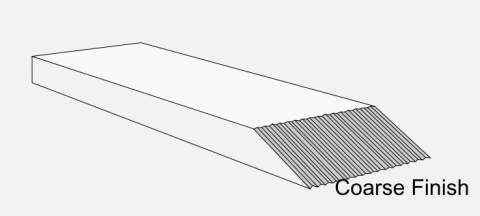
Making a blade keen does not make a weaker blade. Thing about the jagged edge on the coarse blade edge. They project out all by themselves. If the finish were finer, then the blade would be stronger. So honing and stropping should be making the blade edge stronger as well.
Some tools using blades, are set to run in a straight line. For example a rabbet plane. Typically the blade in the best of these planes are skewed.
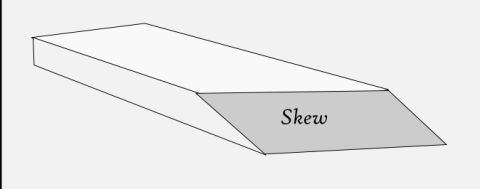
Just like taking a road or path winding back and forth on a mountain is easier than climbing straight up, a skewed edge will act exactly like a much sharper blade. So by being skewed a blade can act sharper even though it retains the strength of the actual angle of the blade. Because the angle is skewed, the blade does not hit obstacles straight on, so it acts as if it were tougher. As a result, skewed blades are often prefered to straight ones. pushing a chisel or plane at an angle, will have this same effect. A skew is a bit more complicated to make in a blade, and there is often a need for a mirror image skew. So if a tool can be straight, and still used as if it were a skew, then the user has control and the best of all choices can be made.
Bob
 A page Dedicated to My Writing
Hello Bob;
My woodie is a fixed fence rabbet with no skew, and I was expecting to get a lot more use from it this year after re-sharpening it again. It always gets a little better every time I do; your article explains very well why it does, thanks! This year will be with the diamond grit so it should really improve this time. I had thought it good only for softwoods so far, but it mite be able to cut hardwoods after this time. It doesn’t have a nicker either. so I have always found it easier to saw cut a kerf in on the cut line first instead of digging the point of the blade in all the way down to the bottom.
Just waiting for that magical time after Thanksgiving to arrive first….
Skip
I think using the saw, like you do, is a wise option.
Using a saw where one can, is a faster method of removing wood in general than using a plane. I tend to saw, even saw multiple passes first, and chip out. I use planes for finishing.
Bob
Thanks – it’s really self-preservation… even in soft pine, that corner wears off quickly if I don’t (with no nicker). And as you know quite well, sharpenening back to behind a nick eats up blade length in a hurry…. I am really looking forward to using this beast on white oak, it makes a rabbet in a hurry, but only in the one size because the fence is not adjustable. It’s 18″ long – so it needs a long board to register on, but very stable when I do. It is the most expensive handtool I’ve bought, but on close inspection the handle’s been replaced poorly and the whole thing stained the same color. Still, I look at the prices of new woodies and it’s a bargin the way it is.
Skip
[…] Sharpening Tools, Part 4 […]